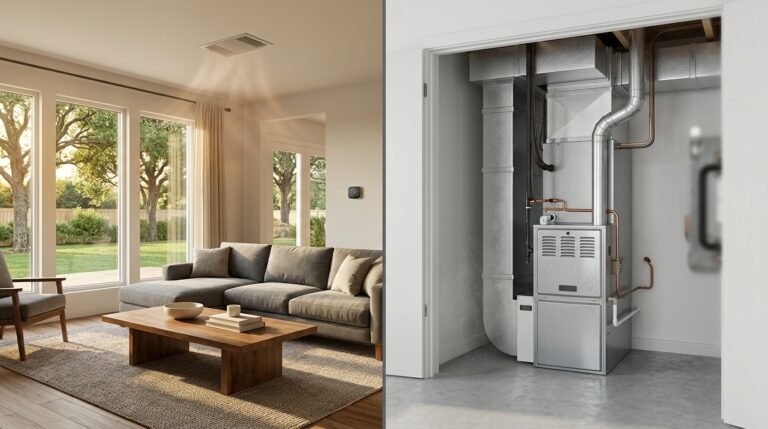
If your upstairs bedrooms bake every summer, your AC runs from noon until midnight, or the furnace struggles on cold January mornings, there is a good chance the problem is right above your head. Ceiling and attic insulation is the main barrier between your living space and an attic that can top 140 degrees on a Burleson summer afternoon and drop below freezing in winter. It is also one reason a furnace can run nonstop, as we explain in why your furnace won’t turn off.
But which type of insulation is best? The honest answer is that it depends on your attic, your budget and your goals. This guide walks through the main ceiling insulation types, how they compare, and what tends to work best in North Texas homes.
First, What Does R-Value Mean?
R-value measures how well a material resists heat flow. The higher the number, the better it insulates. Two things matter: the R-value per inch of the material, and the total R-value once it is installed. A thick layer of a modest material can outperform a thin layer of a premium one.
For homes in our climate zone, ENERGY STAR recommends R-30 to R-60 for an uninsulated attic, and adding R-25 to R-38 if you already have 3 to 4 inches. Current energy codes generally call for about R-38 in new construction. Many Burleson homes built before the 2000s have far less, often R-19 or below, especially after years of settling.
The Main Types of Ceiling Insulation
1. Blown-In Fiberglass (Loose-Fill)
R-value: about R-2.2 to R-2.7 per inch.
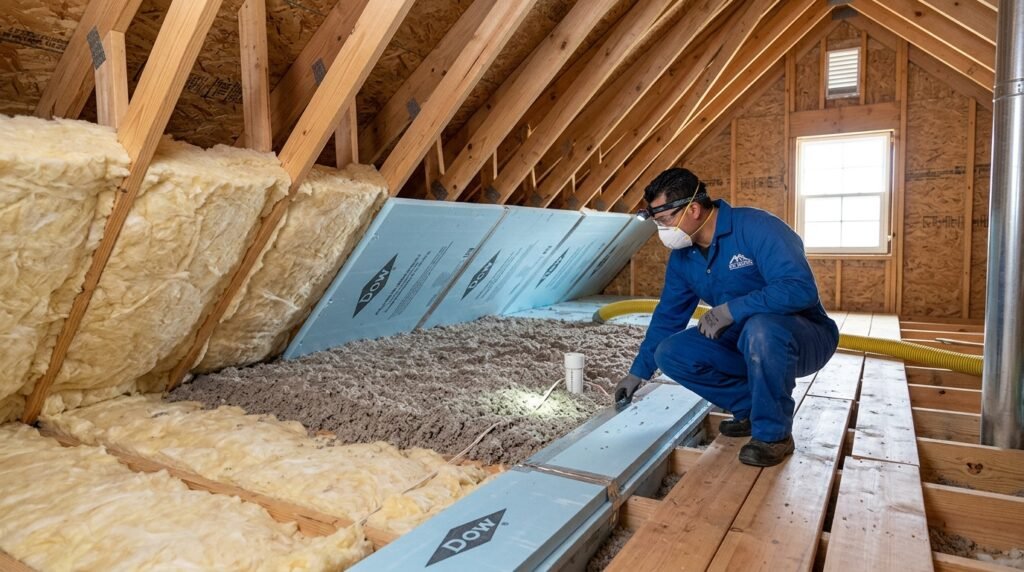
Small fibers of glass are blown across the attic floor with a machine, filling gaps around joists, wires and pipes. Fiberglass does not burn, does not absorb much moisture, and settles very little over time. It is lightweight, so it is safe to pile deep on ceiling drywall. Because its R-value per inch is lower, it needs more depth: roughly 13 to 16 inches to reach R-38.
Best for: topping up an existing attic to today’s recommended levels quickly and affordably.
2. Blown-In Cellulose
R-value: about R-3.2 to R-3.8 per inch.
Cellulose is made mostly from recycled paper treated with borate for fire and pest resistance. It packs more densely than fiberglass, so it does a better job of slowing air movement through the insulation layer and reaches a given R-value with less depth. It is heavier, can settle by up to around 20 percent, and should stay dry; a roof leak that soaks cellulose means it needs to be replaced.
Best for: homeowners who want strong performance per inch and a recycled material, in attics with no moisture problems.
3. Fiberglass Batts and Rolls
R-value: about R-2.9 to R-3.8 per inch, depending on density.
Batts are the familiar pink or yellow blankets that fit between joists. They are inexpensive and easy to handle, which makes them popular for DIY projects and new construction. The catch is that performance depends heavily on installation: gaps, compressed sections and cut-outs around wires and fixtures can reduce real-world effectiveness significantly.
Best for: open framing, knee walls, bonus-room walls and new construction where every bay is accessible.
4. Mineral Wool (Rock Wool) Batts
R-value: about R-3.0 to R-3.3 per inch.
Made from stone and recycled slag, mineral wool is denser than fiberglass, naturally fire-resistant to very high temperatures, water-repellent and excellent at dampening sound. It costs more than fiberglass batts, but it holds its shape well and is easy to cut to a snug fit.
Best for: areas where fire resistance or noise control matters, such as ceilings between floors or rooms over the garage.
5. Spray Foam Insulation
R-value: about R-3.5 to R-3.8 per inch for open-cell; about R-6 to R-7 per inch for closed-cell.
Spray foam expands to fill every crack, so it insulates and air-seals in one step. It is often sprayed on the underside of the roof deck instead of the attic floor, turning the attic into a semi-conditioned space. That can be a big advantage in Texas, where the ductwork and air handler often sit in the attic: they stay far cooler in summer, which reduces energy loss. Spray foam is the most expensive option, must be installed by trained professionals, and changes how the attic is ventilated, so it needs careful planning.
Best for: homes with HVAC equipment and ducts in the attic, cathedral ceilings, or homeowners planning to stay long-term who want maximum performance.
6. Rigid Foam Board
R-value: about R-4 (EPS) to R-5 (XPS) to R-6.5 (polyiso) per inch.
Rigid panels deliver high R-value in a thin profile. In ceilings they are mostly used for specific spots: insulating the attic hatch or pull-down stairs, cathedral ceilings, and knee walls. A well-insulated, weatherstripped hatch closes one of the biggest air leaks in many homes.
7. Radiant Barriers
A radiant barrier is not insulation in the usual sense; it is a reflective foil, typically stapled to the underside of the roof rafters. Instead of slowing heat conduction, it reflects the sun’s radiant heat back toward the roof, keeping the attic cooler. According to the U.S. Department of Energy, radiant barriers are most effective in hot, sunny climates and can reduce cooling costs by roughly 5 to 10 percent. They work best in addition to proper insulation, not instead of it.
Ceiling Insulation Types at a Glance
| Type | R-value per inch | Relative cost | Key strength |
|---|---|---|---|
| Blown-in fiberglass | 2.2 – 2.7 | Low | Affordable, fast, won’t settle much |
| Blown-in cellulose | 3.2 – 3.8 | Low to moderate | Dense, good air resistance, recycled |
| Fiberglass batts | 2.9 – 3.8 | Low | DIY-friendly for open framing |
| Mineral wool batts | 3.0 – 3.3 | Moderate | Fire resistance and soundproofing |
| Spray foam | 3.5 – 7.0 | High | Insulates and air-seals in one step |
| Rigid foam board | 4.0 – 6.5 | Moderate | High R-value in thin spaces |
| Radiant barrier | N/A (reflective) | Low to moderate | Blocks radiant heat from the roof |
What Works Best for Burleson Homes?
For most existing homes in Burleson, the best value is blown-in fiberglass or cellulose to R-38 or higher, combined with air sealing and, where the attic gets intense sun, a radiant barrier. Homes with the air handler and ducts in a hot attic, or owners who want the highest performance, should consider spray foam on the roof deck. Batts and mineral wool fill in the gaps for knee walls, bonus rooms and open framing, and rigid foam is ideal for the attic hatch.
Whatever you choose, a few rules make the difference between a good job and a disappointing one:
- Air seal first. Seal gaps around light fixtures, plumbing and wiring holes, top plates and the attic hatch before adding insulation. Insulation slows heat; it does not stop air leaks.
- Keep soffit vents open with baffles so the attic can breathe and moisture does not build up.
- Respect clearances. Keep insulation the required distance from furnace and water heater flue pipes, and do not cover recessed lights unless they are rated for insulation contact (IC-rated).
- Deal with problems first. Wet, moldy or rodent-contaminated insulation should be removed, and roof leaks repaired, before new material goes in.
How Better Insulation Helps Your HVAC System
Insulation and your heating and cooling system work as a team. A well-insulated ceiling means shorter run times, more even temperatures between floors, and less wear on your equipment. It is one of the most effective fixes for rooms that never get comfortable, a common issue covered in our guide to 11 problems your heating system may experience this winter. Sealing drafts and checking insulation is also part of our checklist on how to prepare your heating system for winter.
Upgrading insulation can even change the size of the system your home needs. If you are planning an AC replacement, insulate first so the new unit can be sized correctly; our guide on how to find the tonnage of your AC unit explains why sizing matters. If your ducts or air handler sit in the attic, our comparison of air handlers vs furnaces explains what that equipment does, and sealing leaky ducts during duct cleaning adds to the savings.
Get Expert Help With Your Attic Insulation in Burleson
Not sure what is in your attic now, or how much more you need? HVAC Repair Burleson offers attic insulation checks. We measure your current depth and R-value, look for air leaks, ventilation and moisture issues, and recommend the right material for your home. Learn more about our attic insulation services, call (817) 839-0304 or request an insulation check online.