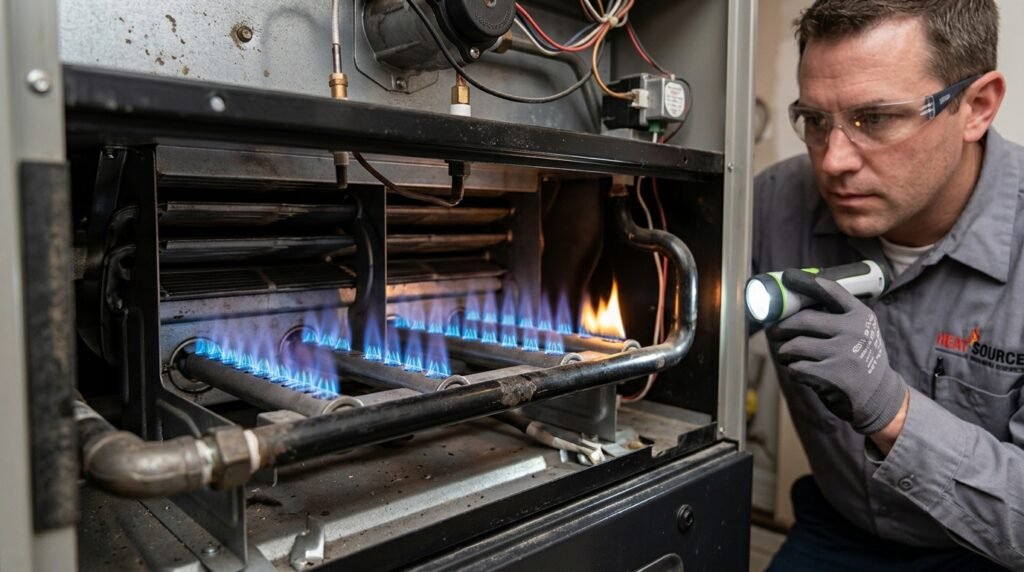
Most homeowners never look at the flame inside their furnace, but it is one of the easiest health checks you can do. The color and behavior of the burner flames tell you how cleanly your furnace is burning natural gas, and a change in color can be an early warning of a problem that affects your safety, your energy bills and the life of the equipment. If your furnace is also blinking a status light, our guide to a furnace flashing red light explains how to read those codes.
Here is what each flame color means, how to check it safely, and when to call a technician.
How to Look at Your Furnace Flame Safely
On most gas furnaces you can see the burners through a small sight glass or window in the front panel. Turn the thermostat up a few degrees so the furnace starts a heating cycle, wait a minute for the burners to light, and look through the window.
- Do not remove the burner cover or blower door while the furnace is running. Doors have safety switches, and the burner area contains open flame and hot surfaces.
- Never put anything into the burner area or try to adjust the air shutters yourself.
- Many high-efficiency furnaces have a sealed combustion chamber with only a tiny viewing port, or none at all. If you cannot see the flame, leave it to your technician during a tune-up.
Blue Flame: A Healthy Furnace
A crisp, steady blue flame, often with a lighter blue inner cone, is exactly what you want to see. It means natural gas and air are mixing in the right proportion and the fuel is burning completely. Complete combustion produces mostly heat, water vapor and carbon dioxide, delivers the most heat from every unit of gas, and minimizes carbon monoxide.
A tiny yellow or orange tip at the end of an otherwise blue flame is usually normal, especially on older burners. So are occasional orange flecks or streaks that come and go, which are often just dust burning off at the start of the season. If you notice a dusty smell along with them, our guide to a burning smell from your furnace explains what is normal.
Yellow or Orange Flame: Incomplete Combustion
A flame that is mostly yellow or orange, lazy, or tall and floppy is a sign that the gas is not burning completely. This is the most important color change to take seriously, because incomplete combustion produces more carbon monoxide (CO) and soot. Common causes include:
- Dirty or rusty burners that disrupt the gas flow.
- A blocked air intake or air shutter, so the flame is not getting enough oxygen.
- Incorrect gas pressure or a worn gas valve.
- Venting or draft problems, such as a blocked flue, a disconnected vent pipe or a clogged intake pipe on a high-efficiency furnace.
- A cracked heat exchanger that lets air from the blower disturb the flame.
Other warning signs often appear alongside a yellow flame: black soot around the burners or the furnace cabinet, stuffy or stale-smelling air, heavy condensation on windows, or family members with headaches, dizziness or nausea that improve when they leave the house. Carbon monoxide itself is odorless and invisible, so a working CO alarm is essential. Learn more in our guide to carbon monoxide and your HVAC system.
What to do: turn the furnace off at the thermostat, check that your CO alarms are working, and call a licensed technician. If a CO alarm sounds or anyone feels ill, get everyone outside and call 911.
Red Flame
A deep red or heavily red-orange flame is uncommon in a gas furnace and usually signals severe incomplete combustion or heavy contamination in the burners. Treat it the same way as a yellow flame: shut the furnace off and have it inspected before using it again.
Green, Purple or Pink Tints
Unusual colors are usually caused by something in the air or on the burners reacting with the flame rather than by a gas problem:
- Green or blue-green streaks can come from copper corrosion near the burners or from chemical residue, such as cleaning products or aerosols used near the furnace.
- Pink, red-purple or orange tinges are often caused by minerals carried in the air from a whole-home humidifier, or by salts and particles in household dust.
These tints are usually not dangerous on their own, but they are worth mentioning to your technician, since corrosion and contamination can damage furnace parts over time.
Watch How the Flame Behaves, Too
Color is only half the story. A healthy flame is steady and sits evenly on each burner. Call for service if you see:
- Flames that flicker, dance or lean when the blower fan starts. A flame that suddenly changes shape when the blower comes on is a classic sign of a possible cracked heat exchanger.
- Flames that lift off the burner, fail to light evenly across all burners, or produce a loud boom when igniting, which can point to delayed ignition or a gas pressure problem.
- Flames rolling out of the burner area toward the front of the furnace. This is a serious safety issue and usually trips the flame rollout switch.
- Flames that start and then go out after a few seconds, often caused by a dirty flame sensor, one of the issues covered in our list of 11 problems your heating system may experience this winter.
Don’t Forget Your Other Gas Appliances
The same rules apply to the pilot light on an older furnace, a gas water heater and your gas stove. A healthy flame is blue; a mostly yellow, lazy flame means the appliance should be cleaned and checked. And if you ever smell rotten eggs, which can mean a gas leak, leave the home right away and call 911 or Atmos Energy at 866-322-8667 from outside.
How to Keep Your Furnace Flame Blue
A clean, blue flame is the result of a well-maintained furnace. During a yearly furnace tune-up, a technician cleans the burners and flame sensor, checks gas pressure, inspects the heat exchanger and venting, and tests for carbon monoxide. Changing your air filter regularly and keeping the area around the furnace free of dust and stored chemicals also helps. For a complete pre-season checklist, see how to prepare your heating system for winter.
If your furnace is old, has a cracked heat exchanger, or keeps producing a poor flame after cleaning, it may be time to compare repairs with a new, high-efficiency furnace replacement. And if you are unsure whether a flame problem can wait until morning, our guide on when an HVAC problem is an emergency applies to heating too.
Seeing a Yellow Flame in Burleson? Call Us
A furnace flame that is not blue is your furnace asking for attention. HVAC Repair Burleson provides fast, licensed furnace repair, including burner cleaning, combustion and carbon monoxide testing, and heat exchanger inspections. Call (817) 839-0304 or request service online.